Operations & Maintenance
Why Operations & Maintenance Determine Long-Term Asset Performance
Energy assets are bought on their installed capacity but judged on their delivered performance over many years. What happens after commissioning — how an asset is operated and maintained — decides whether that capacity translates into safe, reliable, long-lived value.
It is easy to treat an energy project as complete once the equipment is installed and the system is switched on. In reality, installation is the beginning of the part that matters most. A solar array, a battery system, a generator or a distribution board does not deliver value at the moment it is commissioned — it delivers value across the years it runs safely and reliably afterwards. That performance is not automatic. It is the product of disciplined operations and maintenance.
The Asset Lifecycle Does Not End at Installation
Every energy or infrastructure asset moves through a lifecycle: equipment supply, installation, testing and commissioning, monitoring, maintenance, upgrade and, eventually, replacement. Operations and maintenance — O&M — is the long middle of that lifecycle, and it is where most of the asset's working life is actually spent. Decisions made when equipment is specified, supplied and installed set the potential of an asset; O&M determines how much of that potential is realised, and for how long.
Treating O&M as an afterthought is one of the most common and most expensive mistakes in energy projects. Equipment that is well specified but poorly maintained degrades faster, fails more often and is retired earlier than it should be. The capital cost is the same; the value delivered is far lower.
Availability, Reliability and the Cost of Downtime
For any operation that depends on power, the practical measure of an asset is not its nameplate rating but its availability — the proportion of the time it is ready to do its job when needed. Availability is won or lost through operations and maintenance. Planned, preventive maintenance keeps equipment within its operating envelope and catches wear before it becomes failure; reactive-only maintenance waits for failure and pays for it in unplanned downtime.
Downtime is rarely just the cost of a repair. For industrial and commercial operations, an outage can mean interrupted production, spoiled processes, idle labour and knock-on damage to other equipment. A maintenance regime that protects availability is therefore not an operating expense to be minimised — it is a form of risk management that protects the far larger value the asset exists to serve.
“The commercial life of an energy asset does not begin at installation. It begins after installation.”
Monitoring: Maintenance Begins With Knowing
Good maintenance depends on good information. Monitoring — measuring how an asset is actually performing against how it should perform — is what turns maintenance from guesswork into a disciplined activity. Trends in output, efficiency, temperature, load and fault behaviour reveal problems while they are still small and inexpensive to correct.
This is where operations and maintenance connect directly to the earlier stages of the lifecycle. An asset that was designed with monitoring, access and maintainability in mind is far easier to keep in good condition than one where these were not considered. Long-term performance is easiest to protect when it is planned for from the design stage, not retrofitted after problems appear.
Safety Is Inseparable From Maintenance
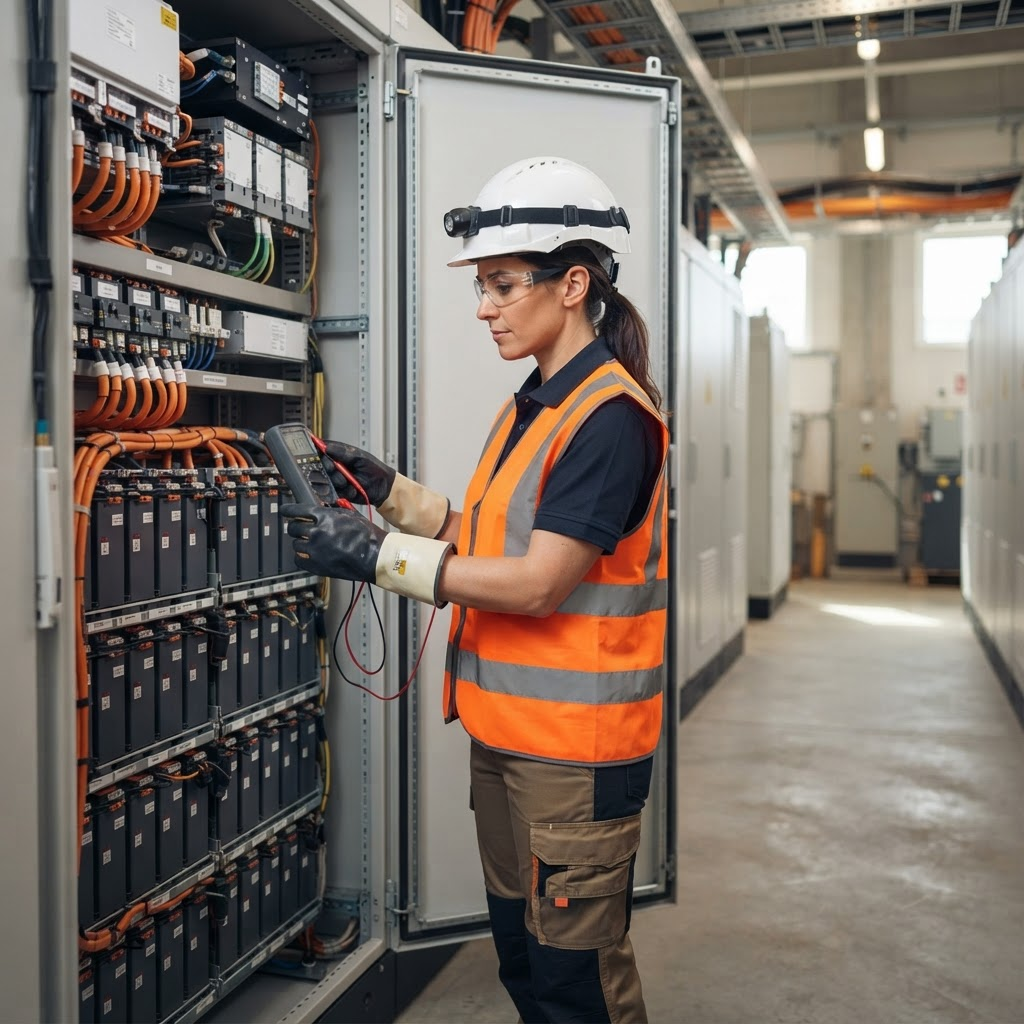
Electrical and energy infrastructure carries real hazards, and those hazards are managed — or created — through the way assets are operated and maintained. Safe maintenance depends on competent people, correct procedures, appropriate protective equipment and adherence to recognised technical and safety standards. In Nigeria, the electricity supply industry operates within a defined health-and-safety and technical framework, including the safety code issued by the Nigerian Electricity Regulatory Commission and the technical standards and certification framework administered by the Nigerian Electricity Management Services Agency.
Maintenance is not only about keeping an asset productive; it is about keeping people and property safe around it. A credible O&M approach treats safety and reliability as the same discipline, delivered by qualified personnel working to the applicable standards rather than to convenience.
Upgrade, Renewal and Whole-of-Life Value
Assets and their operating context change over time. Loads grow, technology improves, and components reach the end of their useful life. Part of responsible operations and maintenance is recognising when the right action is not another repair but a targeted upgrade or renewal — replacing an ageing component, adding capacity, or integrating storage or additional generation as needs evolve.
Seen this way, O&M is not a holding pattern that keeps an asset unchanged until it fails. It is active stewardship of whole-of-life value — extending useful life where that is sound, and reinvesting deliberately where it is not. That same long-term orientation is what makes an asset's performance sustainable in every sense: efficient, safe and durable over its full life rather than only at the point of handover.
A Lifecycle Discipline, Not a Line Item
The strongest energy projects are conceived as complete lifecycles: equipment supply, installation, testing and commissioning, monitoring, maintenance, upgrade and long-term asset performance, treated as one continuous responsibility rather than separate transactions. Equipment supply and installation are core parts of project delivery, but long-term asset performance also depends on proper commissioning, monitoring, maintenance and lifecycle planning.
Understood this way, the value of an energy project follows a single connected sequence — equipment supply, installation, testing and commissioning, monitoring, maintenance, upgrade and long-term asset performance — in which operations and maintenance is the stage that tests whether every earlier decision endures or unravels. For asset owners and project developers, the practical conclusion is simple: plan for the whole lifecycle from the outset, resource each stage properly, and treat long-term performance as central to the value of the asset rather than a cost to be trimmed. That integrated view — spanning supply and installation through to lasting performance — is how MEELK Energy is positioned to participate across the complete energy-asset lifecycle, subject to project scope and requirements.
References & Official Sources
For authoritative information on safety obligations and technical standards in the Nigerian electricity supply industry, consult the official publications of the relevant public institutions. MEELK Energy Limited is an independent company and is not affiliated with these bodies; no figures or data in this article are drawn from them.
- Nigerian Electricity Regulatory Commission (NERC)
Health & Safety Code for the Nigerian Electricity Supply Industry — Second Edition, March 2026, setting safety obligations across the electricity supply industry.
- Nigerian Electricity Management Services Agency (NEMSA)
Technical standards, statutory mandate and certification framework for electrical installations, inspection and testing in Nigeria.