
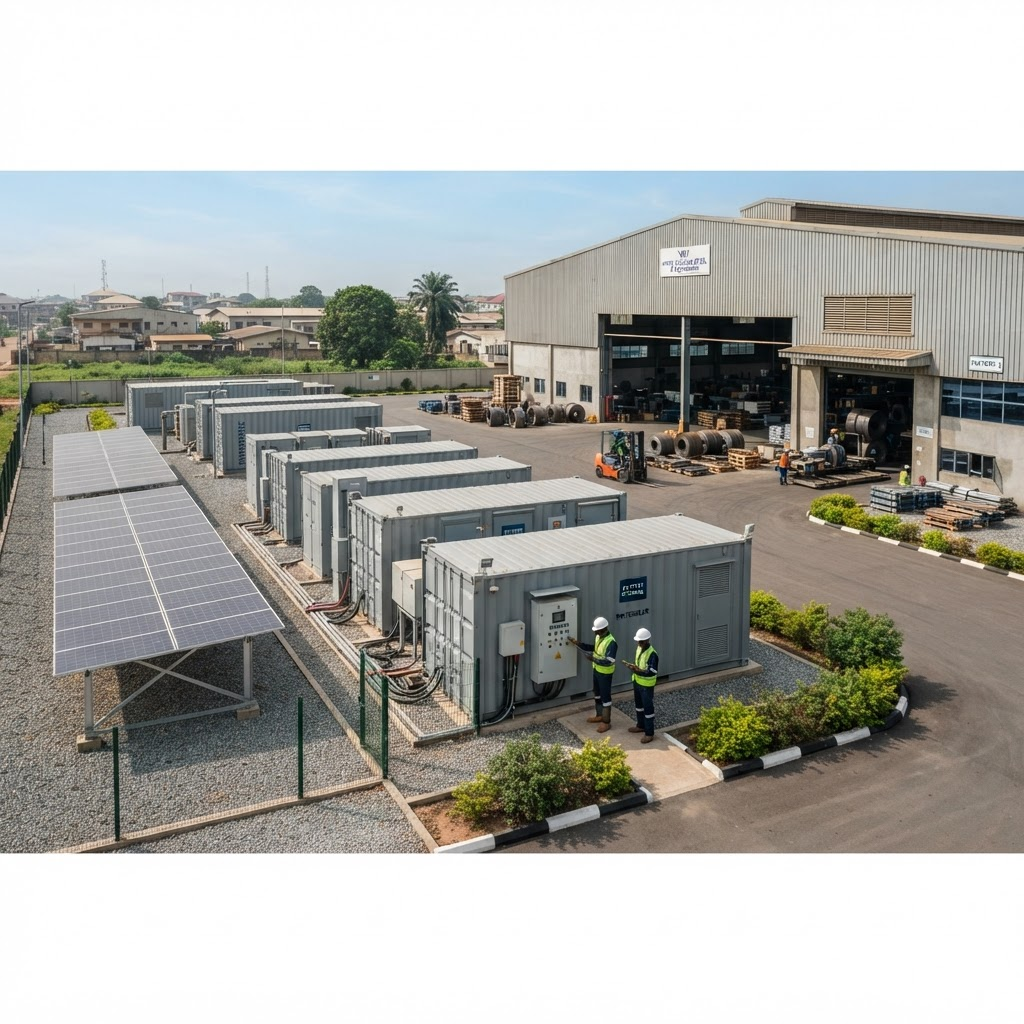
Power & Distributed Energy
The Role of Distributed Energy in Nigeria's Industrial Growth
Reliable, flexible power increasingly determines whether industrial operations can grow. For many manufacturers and commercial users, the question is no longer only how to obtain power, but how to architect it.
Industrial growth depends on many things — demand, capital, skills, logistics — but few constraints are as immediate as energy. When power is unreliable or inflexible, production plans bend around it. When power is dependable and well-structured, energy recedes into the background and lets the business focus on output. Distributed energy has become central to that shift because it moves generation, and often storage, closer to where energy is actually used.
Why Industrial Growth Depends on Energy Architecture
Energy architecture describes how a facility sources, generates, stores, distributes and manages its power — not simply how much capacity it has. Two operations with identical rated capacity can perform very differently depending on how their systems are designed. Architecture determines how a site responds to interruptions, how it handles peaks, how it absorbs the cost of fuel or tariffs, and how easily it can expand later.
For industrial users, this matters because the cost of poor power is rarely limited to the energy bill. It shows up as lost production, damaged equipment, spoiled material, idle labour and constrained expansion. A considered energy architecture treats those risks as design inputs rather than accepting them as unavoidable operating conditions.
The Limits of a Grid-Only Mindset
A grid-only approach treats the public supply as the default and everything else as emergency backup. That framing can work where supply is consistent, but it leaves little room to manage reliability, cost or resilience on the operator's own terms. Backup-first thinking also tends to under-invest in the systems that would otherwise turn on-site generation into a genuinely productive asset.
The more useful starting point is to ask what the operation actually needs — the critical loads, the tolerance for interruption, the cost sensitivity, the growth trajectory — and then design an architecture that meets those needs, whatever combination of grid, generation, renewables and storage that implies.
“The better question is: What energy architecture best supports our operation?”
What Distributed Energy Actually Changes
Distributed energy places generation and storage near the point of use. Depending on the site, that can mean captive power, embedded generation, solar, battery storage, hybrid systems, or a combination coordinated by a control layer. The practical effect is greater control: the operator can prioritise critical loads, shape how and when energy is drawn, and reduce dependence on a single point of supply.
Distributed systems also tend to be more modular. Capacity can be added in steps that track demand, rather than committing to large, fixed infrastructure long before it is needed. For a growing industrial operation, that flexibility can be as valuable as the energy itself.
Reliability, Cost and Control
Reliability is the most visible benefit, but it is not the only one. A well-designed distributed system can smooth peaks, manage the balance between different energy sources, and give the operator clearer visibility of consumption. Over time, that visibility supports better decisions about efficiency and expansion.
Cost behaves differently too. Instead of a single exposure to tariff or fuel movements, a distributed architecture can blend sources to manage overall energy cost across the asset's life. The objective is not the lowest headline price on any single input, but the most stable and predictable total cost of reliable power.
Structuring Projects Around Real Demand
The strongest distributed-energy projects begin with demand, not equipment. Load profiles, operating hours, critical processes, site constraints and growth plans shape what should be built. Systems designed from a genuine understanding of demand are more likely to perform as intended and to remain economic over their full life.
This is where design discipline matters. Oversized systems waste capital; undersized systems disappoint. Matching the architecture to the real requirement — and to the applicable commercial and regulatory framework — is what separates a system that looks impressive from one that quietly does its job for years.
Regulation and Responsible Delivery
Distributed energy operates within a regulatory framework covering generation, embedded and captive power, metering, safety and environmental responsibility. The specific licences, permits and approvals depend on the nature and scale of each project. Responsible delivery means designing within that framework from the outset, rather than treating compliance as an afterthought.
It also means being honest about what a project can and cannot do. Every site is different, and sound conclusions come from project-specific technical, commercial, legal and regulatory assessment — not from generalisations.
References & Official Sources
For authoritative information on Nigeria's power-sector policy, regulation and rural electrification, consult the official publications of the relevant public institutions. MEELK Energy Limited is an independent company and is not affiliated with these bodies; no figures or data in this article are drawn from them.
- Federal Ministry of Power
National power-sector policy and programmes.
- Nigerian Electricity Regulatory Commission (NERC)
Regulation of the electricity supply industry, including embedded and captive generation.
- Rural Electrification Agency (REA)
Rural electrification, mini-grid and off-grid programmes.
- Energy Commission of Nigeria (ECN)
National energy planning and policy coordination.