
Renewable Energy & Storage
Why Battery Storage Is Becoming Critical to Commercial Power
For many commercial and industrial users, battery storage is moving from a backup afterthought to a core part of how power is managed — shaping reliability, peak demand and the overall cost of energy.
Battery energy storage has quietly become one of the most important components in modern commercial power. For years it was treated as a niche or emergency measure — something added at the margins once everything else was in place. Increasingly, it sits at the centre of how commercial and industrial operations think about reliability, cost and control. The change is less about the technology being new and more about how it is being used.
From Backup Afterthought to Core Infrastructure
Traditionally, a commercial site relied on the grid, with a generator standing by for outages. Storage, where present at all, was a small buffer. That model kept storage on the edge of the system and out of everyday operating decisions. As reliability pressures and energy costs have grown, operators have started to ask what storage can do when it is designed in from the beginning rather than bolted on at the end.
Treated as core infrastructure, a battery system does more than hold energy for an outage. It becomes an active part of how a facility balances its supply, manages peaks and smooths the transitions between different energy sources. That shift in role — from passive backup to active management — is what makes storage increasingly central to commercial power.
Reliability When Supply Is Unpredictable
The most immediate value of storage is continuity. Where public supply is intermittent, a well-sized battery system can carry critical loads through interruptions without the delay, noise and wear associated with starting generation for every dip. For processes that cannot tolerate interruption, that seamless bridge is often the difference between a minor event and a costly one.
Reliability, though, is a design outcome rather than a property of the battery alone. It depends on understanding which loads are truly critical, how long they must be supported, and how the storage system coordinates with the grid, generation and any renewable sources on site.
Working With Solar and Renewable Integration
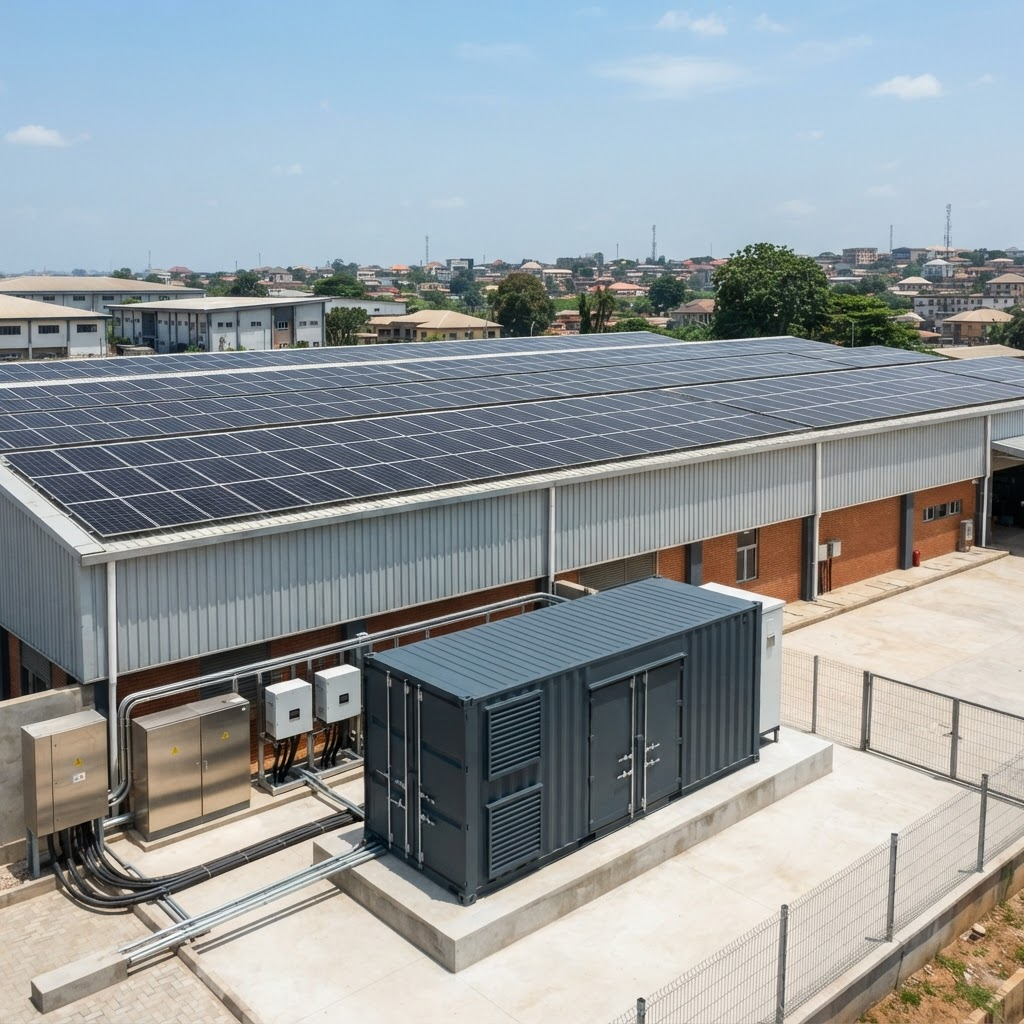
Storage and solar are natural partners. Solar generation follows the sun, not the load, so without storage much of its value is limited to daylight hours and to whatever demand happens to coincide with generation. A battery lets a site capture surplus generation and use it when it is actually needed, extending the practical contribution of a renewable system well beyond the middle of the day.
In hybrid systems, storage also acts as a stabilising layer, absorbing variability and helping different sources work together smoothly. The result is a more predictable supply built from less predictable inputs — which is precisely what commercial operations need.
“The objective is not to install the largest possible battery. It is to install the right battery for the operational need.”
Optimising Generators, Not Just Replacing Them
Storage does not have to displace existing generation to be worthwhile. In many commercial settings, the more immediate opportunity is to make generation work better. Generators are least efficient and most stressed when they run lightly loaded or cycle frequently to follow small changes in demand. A battery can absorb that variability, allowing generation to run closer to its efficient range and to switch off entirely during periods that storage can cover.
Used this way, storage becomes an optimisation layer across the whole energy system. The aim is a coordinated architecture — grid, generation, renewables and storage working together — rather than any single source carrying the entire burden.
Cost, Sizing and Lifecycle Planning
Storage decisions are as much commercial as technical. A battery system represents a real investment, and its value depends on how well it is matched to the operation it serves. Oversized systems tie up capital that earns little return; undersized systems fail to deliver the reliability or savings expected of them. Sound sizing begins with the load profile, the critical requirements and the role the battery is intended to play.
Lifecycle planning matters just as much as the initial specification. Battery systems operate over many years, and their performance, maintenance and eventual replacement should be considered from the outset. The most useful measure is not the headline price of the equipment but the stability and predictability it brings to the total cost of reliable power over its life.
Designing Storage Around the Operational Need
The strongest storage projects start with the operation, not the battery. What are the critical loads? How long must they be supported? How does demand move across the day and the year? What is already on site, and how should storage complement it? These questions shape a system that performs as intended and remains economic over time.
This is where design discipline is decisive. Matching the architecture to the real requirement — and to the applicable commercial and regulatory framework — is what separates storage that quietly does its job for years from storage that disappoints.
Regulation and Responsible Delivery
Energy storage sits within a regulatory framework covering generation, embedded and captive power, metering, safety and environmental responsibility. The specific licences, permits and approvals depend on the nature and scale of each project. Responsible delivery means designing within that framework from the outset rather than treating compliance as an afterthought.
It also means being honest about what a system can and cannot do. Every site is different, and sound conclusions come from project-specific technical, commercial, legal and regulatory assessment — not from generalisations.
References & Official Sources
For authoritative information on Nigeria's power-sector policy, regulation and electrification programmes, consult the official publications of the relevant public institutions. MEELK Energy Limited is an independent company and is not affiliated with these bodies; no figures or data in this article are drawn from them.
- Federal Ministry of Power
National power-sector policy and programmes.
- Nigerian Electricity Regulatory Commission (NERC)
Regulation of the electricity supply industry, including embedded and captive generation.
- Rural Electrification Agency (REA)
Off-grid, mini-grid and solar-hybrid programmes that increasingly incorporate storage.
- Energy Commission of Nigeria (ECN)
National energy planning and policy coordination.